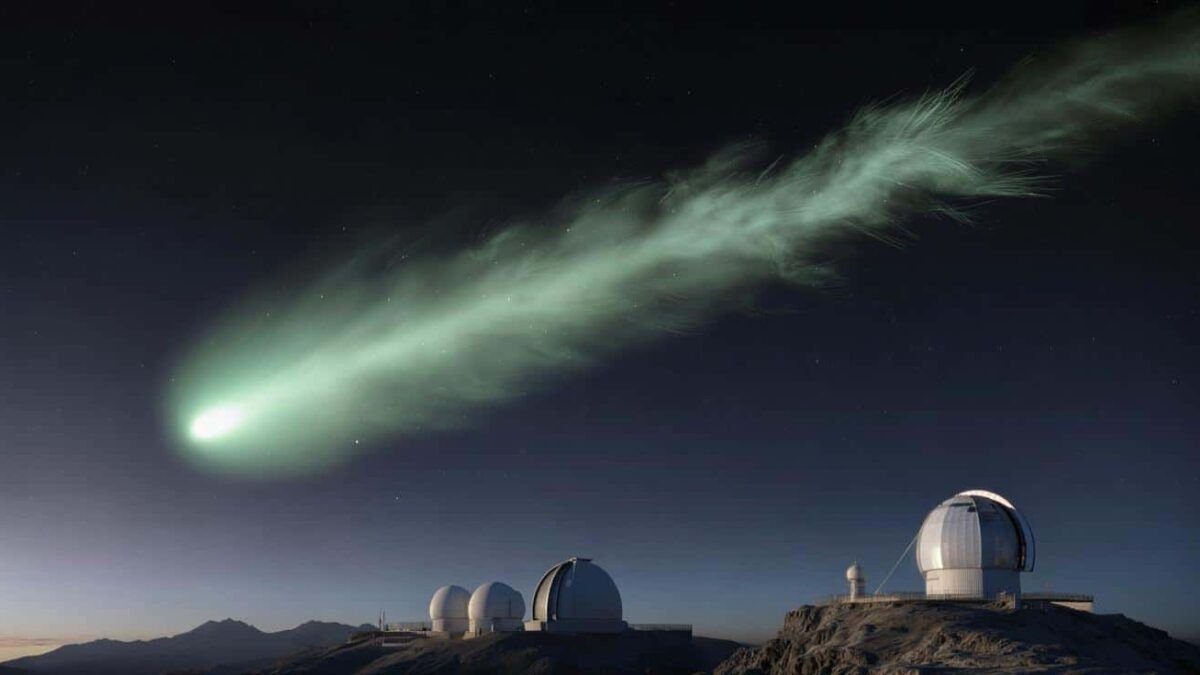
In the quiet predawn skies over Chile, astronomers held their breath as a mesmerizing emerald streak emerged on their monitors, cutting through the void like a ghostly brushstroke. This ethereal vision was none other than the interstellar comet 3I ATLAS, a fleeting guest from beyond our Solar System, now captured in jaw-dropping detail by leading telescopes worldwide. These spectacular new images offer a front-row seat to a cosmic phenomenon, blending artistry with groundbreaking science.
From the volcanic heights of Mauna Kea in Hawaii to the starry peaks of the Canary Islands, observatories united to document this wanderer across multiple wavelengths. What started as a faint blur has transformed into vivid portraits revealing intricate tails and glowing comas, igniting excitement among stargazers and scientists alike.
Unveiling the Mysteries of Interstellar Comet 3I ATLAS
The interstellar comet 3I ATLAS, the third confirmed object from outside our Solar System, showcases a delicate nucleus shrouded in a luminous green coma. Its expansive tail, stretching millions of kilometers, twists under the influence of solar winds, creating a dynamic spectacle unlike anything in our local comet family.
These fresh captures elevate it from a distant streak to a textured marvel. Astronomers describe the moment of revelation as electric, with screens lighting up to expose subtle warps and faint halos that hint at its long journey through interstellar space.
Key Observatories and Their Breakthrough Views
The Very Large Telescope (VLT) in Chile delivered ultra-sharp ground-based images, highlighting the comet’s warped tail shaped by unseen forces. Meanwhile, Gemini North on Mauna Kea provided ultraviolet glimpses of a subtle gas envelope, while infrared data from the Gran Telescopio Canarias hinted at exotic dust grains foreign to Solar System comets.
- VLT (Chile): Captured high-resolution details of tail distortions.
- Gemini North (Hawaii): Revealed faint gas emissions in UV light.
- Gran Telescopio Canarias (Spain): Uncovered unique infrared signatures of alien particles.
Its hyperbolic orbit—too rapid for the Sun’s gravity to bind—confirms origins in a distant star system. By analyzing brightness shifts and tail bends, experts reconstruct its path, uncovering influences from gas jets and stellar gravity encountered eons ago.
The Global Race to Image 3I ATLAS
Discovered by Hawaii’s ATLAS survey, a network of robotic telescopes hunting near-Earth objects, 3I ATLAS initially appeared as an ordinary streak. Precise orbital calculations quickly revealed its interstellar trajectory, triggering a worldwide scramble for observation time.
Teams across continents coordinated via instant alerts and video calls, prioritizing this rare event over routine schedules. The comet’s brief visibility window demanded flawless synchronization of equipment and weather conditions.
- Astronomers at Gemini North pivoted from deep-space galaxies to track the fast-moving intruder.
- VLT operators in Chile paused to admire the comet naked-eye before diving into data.
- High-altitude sites like La Palma offered pristine skies for the clearest shots.
This collaborative frenzy mirrors the thrill of a cosmic treasure hunt, where split-second decisions yield images that preserve the comet’s ephemeral beauty. Veterans in the field rediscover their passion, blending rigorous protocol with pure wonder.
Scientific Revelations from Multi-Wavelength Images
These spectacular new images go beyond visuals, enabling deep dives into the comet’s makeup. Spectral analysis identifies ices like water and carbon monoxide, possibly laced with compounds from its birth star, offering clues to extrasolar chemistry.
Decoding Composition and Dynamic Activity
Continuous monitoring captures activity surges as 3I ATLAS approaches the Sun, revealing volatile outbursts and dust ejection patterns. Multi-site data refines its trajectory, while color filters expose ionized gases responsible for the signature green glow—not alien tech, but natural solar interactions.
Unlike bound comets, its unbound path suggests ejection from a disrupted planetary system, potentially billions of years ago. These insights challenge models of interstellar object frequency and composition.
Public releases now include annotated guides to demystify the science:
- Details on filters used and key features spotlighted.
- Current sky position, solar distance, and motion rates.
- Trends in brightness and tail evolution.
- Unique contributions from each observatory.
- Open questions for ongoing research.
Implications for Astronomy and Our Cosmic Neighborhood
Interstellar comet 3I ATLAS probes the prevalence of such nomads, many likely overlooked before modern surveys. It hints at origins in shattered worlds or stellar nurseries, reshaping views of galactic debris flows.
For everyday skywatchers, these images humanize the abstract, portraying the Solar System as a cosmic crossroads. Debris from passersby like this could even mingle with our heliosphere, linking local and distant realms.
Upcoming facilities like the Vera C. Rubin Observatory will multiply detections, promising a new era of interstellar studies. 3I ATLAS underscores global teamwork’s power in unraveling the universe’s vast, interconnected web.
Why 3I ATLAS Continues to Captivate Globally
Its rarity— a hyperbolic traveler unbound by our Sun—evokes solitude across cosmic scales, captured in mere weeks after eons in the void. This serendipity fuels public buzz, with social media ablaze over the haunting visuals.
Educational outreach amplifies the impact:
- Illustrating fluid boundaries of planetary systems.
- Highlighting diversity in cosmic materials.
- Emphasizing survey telescopes’ role in discovery.
In conclusion, the spectacular new images of interstellar comet 3I ATLAS are more than pretty pictures—they’re portals to alien worlds, sparking curiosity and advancing knowledge. As it recedes into the stars, it leaves a legacy of inspiration, reminding us to look up and wonder at the universe’s endless tales. Stay tuned for more revelations from the VLT, Gemini North, and beyond, as astronomy pushes frontiers ever outward.
Can I see interstellar comet 3I ATLAS with my own eyes?
How do astronomers confirm 3I ATLAS is interstellar?
What makes these new images of 3I ATLAS special?
Does 3I ATLAS pose risks to Earth?
Will more interstellar objects be found soon?
