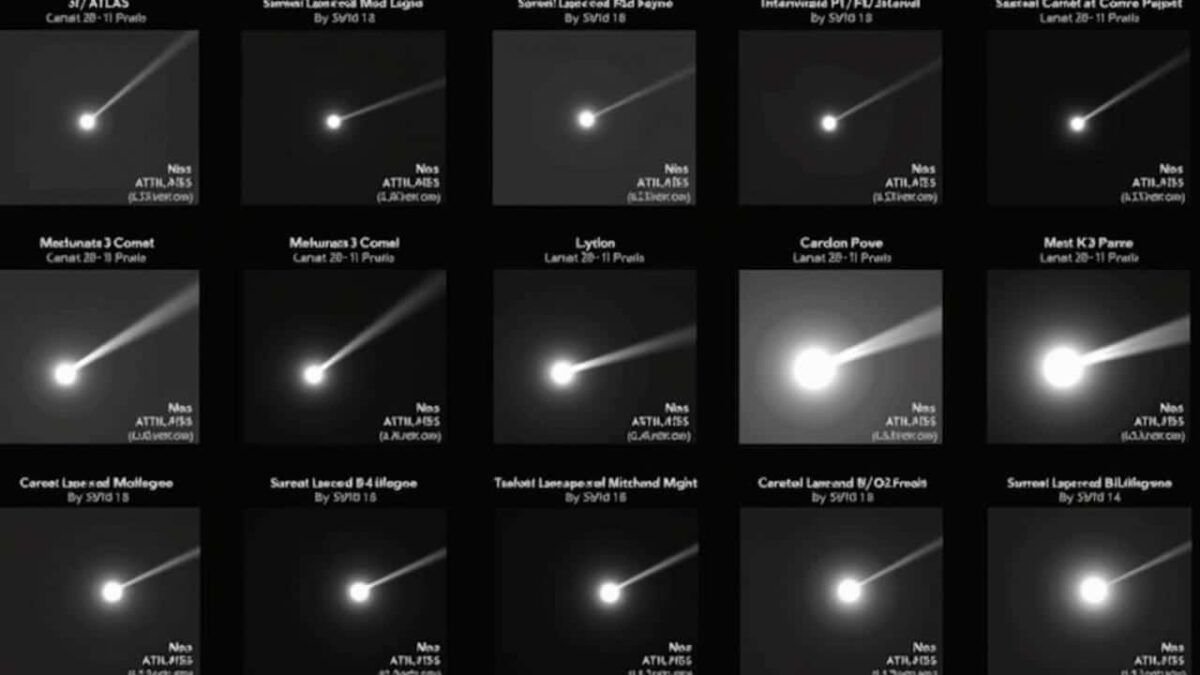
Imagine the buzz in a high-tech control room as the first crisp images of the interstellar comet 3I/ATLAS flicker onto monitors. This elusive cosmic visitor, originating from beyond our Solar System, has been meticulously captured by eight powerhouse spacecraft, satellites, and telescopes. These groundbreaking visuals not only highlight its journey but also unlock secrets about distant star systems, thrilling astronomers and space enthusiasts alike.
The release of these images represents a pivotal moment in astronomy. As 3I/ATLAS races through our cosmic neighborhood, its interaction with solar radiation reveals dynamic changes in real time. This rare opportunity allows scientists to study an extraterrestrial object up close, offering insights that could reshape our understanding of the universe.
Unveiling the Mystery of Interstellar Comet 3I/ATLAS
At first sight, the interstellar comet 3I/ATLAS might seem like a subtle glow against the starry backdrop—a fuzzy patch with a trailing tail. But don’t let its understated appearance fool you; this comet’s extraterrestrial origin makes it extraordinarily special. Originating from interstellar space, it has entered our Sun’s gravitational pull on a path unlike any local comet.
Its trajectory follows a hyperbolic orbit, meaning it’s on a one-way trip with no plans to loop back. hurtling at speeds far beyond typical Solar System objects, 3I/ATLAS provides a unique window into materials preserved from another stellar environment. Astronomers value these flybys immensely, as they deliver data impossible to obtain otherwise.
Previous interstellar visitors, such as ‘Oumuamua and 2I/Borisov, sparked intense scientific curiosity. ‘Oumuamua baffled experts with its elongated shape and unexpected acceleration, while 2I/Borisov showed comet-like activity but at interstellar velocities. 3I/ATLAS combines familiar comet behaviors with its profound alien heritage, making it a fascinating bridge between the known and the unknown.
- Compact nucleus: A resilient icy core that holds together despite solar proximity.
- Delicate coma: A gaseous envelope formed by sublimating ices, creating subtle jets.
- sweeping tail: Composed of dust particles and ions, extended by relentless solar winds across vast distances.
What makes 3I/ATLAS truly remarkable is its serendipitous detection. Among countless interstellar wanderers, it crossed paths with our advanced observation networks at the perfect time. The resulting multi-angle imagery acts like a snapshot from a far-off stellar nursery, preserved for our analysis.
The Collaborative Triumph of Eight Advanced Observatories
Capturing 3I/ATLAS required seamless international teamwork. Astronomers worldwide exchanged urgent alerts through digital channels, swiftly reallocating resources from routine observations. Ground-based telescopes sought optimal viewing windows under clear skies, while orbiting spacecraft and satellites fine-tuned their positions for prime shots.
Each of the eight instruments brought irreplaceable expertise to the table, covering a spectrum of wavelengths and perspectives.
- Visible-light telescopes: Provided sharp details of the comet’s coma and central nucleus.
- Infrared detectors: Revealed warm dust grains that evade visible detection.
- Ultraviolet tools: Highlighted volatile gases erupting as powerful jets.
- Wide-field imagers: Charted the expansive tail against the cosmic canvas.
Precision timing amplified the value of these captures—one set imaged the comet’s tight pre-perihelion form, while others documented early signs of disruption post-closest solar approach. Dedicated teams worked through sleepless nights, employing specialized software to process data streams. Even a sharp-eyed student volunteer identified a fresh gas emission, proving the power of collective human insight.
This orchestrated effort creates a richer, layered portrait than any single observatory could achieve. By merging data across wavelengths, researchers construct a 3D evolutionary timeline, probing whether 3I/ATLAS is a fragile aggregate or a robust icy body. Such collaborations set the standard for future cosmic hunts.
Interpreting the Images: From Pixels to Profound Discoveries
These images are accessible even to newcomers—begin by locating the brilliant core, gauging the coma’s expanse, and tracing the tail’s curve. Such observations tell tales of ice vaporization and solar wind sculpting. Layer in context, and the story deepens: 3I/ATLAS transports ancient, frozen compounds awakened by our Sun’s rays.
Spectral analysis uncovers key chemistry, including carbon-laden dust and reactive gases that echo or diverge from our own Oort Cloud comets. Day-by-day changes, like expanding halos and tail distortions, reveal interactions with solar phenomena. These details illuminate planetary formation processes in other systems, challenging assumptions about our Solar System’s exceptionalism.
As a metaphorical time capsule, 3I/ATLAS delivers whispers from remote worlds.
- Dust patterns: Disclose the comet’s spin rate and surface erosion.
- Gas signatures: Hint at its birth environment and composition.
- Path deviations: Measure outgassing influences on motion.
Beyond science, these visuals stir wonder, shared across platforms to remind us of our place in the cosmos. They transform abstract distances into tangible spectacle.
Cosmic Implications and the Future of Interstellar Hunting
The passage of 3I/ATLAS connects our home to the galaxy’s nomadic population. Its everyday comet features emphasize cosmic commonality—simple building blocks fuel epic voyages. Widely disseminated, the images ignite public passion, fostering reflection on universal scales.
Upcoming sky surveys, bolstered by cutting-edge detectors, will uncover more such intruders with greater frequency. Interstellar objects evolve from oddities to vital informants on exoplanet debris. 3I/ATLAS paves the way for deeper dives into galactic dynamics.
In summary, these images are more than data points; they capture a transient alignment of stars and technology. As 3I/ATLAS departs, scientists maximize every datum. Its legacy endures: the universe teems with narratives, ready for discovery by watchful observers. Embrace this thrill—future tools like AI-enhanced telescopes promise a bounty of interstellar revelations, expanding our stellar horizons.
What is the interstellar comet 3I/ATLAS?
How do we confirm it’s interstellar?
Why observe with eight different instruments?
Can amateurs spot 3I/ATLAS?
Will we find more interstellar objects?
