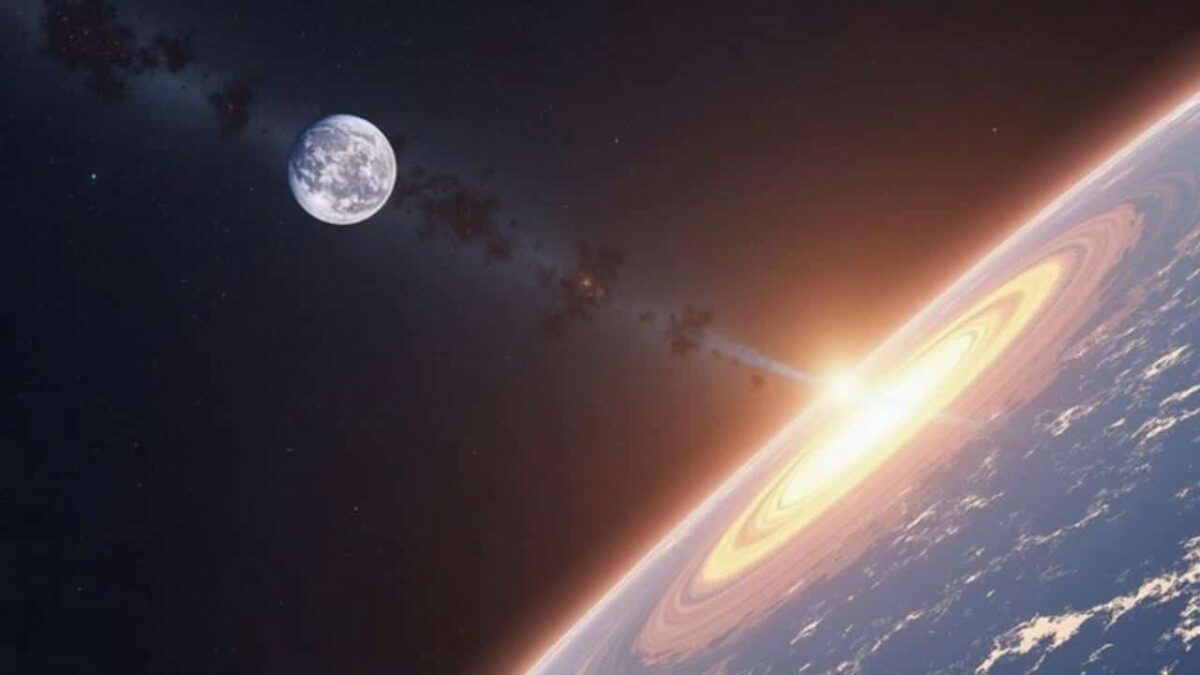
In the high-stakes environment of NASA’s Goddard Space Flight Center in Maryland, researchers huddled around glowing screens as powerful computers hummed relentlessly. Suddenly, a faint yet structured 10-second signal pierced the cosmic background noise—a transmission that had journeyed 13 billion years across the expanding cosmos. This extraordinary detection offers a rare glimpse into the universe’s formative years, thrilling the global astronomy community.
Unlike dramatic sci-fi transmissions, this radio wave pattern emerged distinctly from random interference, suggesting roots in the universe’s toddler phase, mere hundreds of millions of years post-Big Bang. As experts dissected the data, excitement mounted, confirming a genuine artifact from the dawn of cosmic history.
Unraveling the Enigma of NASA’s Ancient Signal
The NASA signal appeared unexpectedly during routine analysis of deep-space observations. Spanning just 10 seconds, it displayed unusual precision that dismissed common sources like pulsars or flares, its brevity amplified by immense travel distances.
Originating from the epoch of initial galaxy formation amid thick hydrogen fog, the burst arrived after cosmic stretching. Scientists merged insights from the James Webb Space Telescope (JWST) with ground-based radio arrays to validate this relic.
A vigilant grad student spotted the irregularity first, sparking intense scrutiny. Teams from Goddard and NASA’s Jet Propulsion Laboratory cross-verified with global assets like ALMA and VLA, ruling out earthly glitches or hardware issues.
Multiple tools locked onto the same 10-second burst from precise sky coordinates, solidifying its authenticity. Key traits included:
- A sharp intensity spike tapering off gradually, with unique frequency shifts.
- Heavy redshift distortion, stretching an original microsecond event into observable seconds due to universal expansion.
- Prime hypotheses: Explosive primordial black hole collisions or nascent galaxy ignitions.
This meticulous vetting underscores the precision required to isolate cosmic gems from data deluges.
Cutting-Edge Techniques Fueling the Breakthrough
Detecting whispers from cosmic antiquity demands state-of-the-art tools and persistent vigilance. Global networks align space-based and terrestrial telescopes for prolonged sky sweeps, filtering out local distractions to amplify remote signals.
After recording, advanced software purges solar flares, atmospheric distortions, and human-made radio clutter. Machine learning algorithms, honed on historical datasets, swiftly flag anomalies like this 13 billion-year-old signal, slashing error rates.
Such innovations transform raw petabytes into actionable insights, enabling faster discoveries in the vast astronomical haystack.
Global Collaboration in Action
Facilities worldwide contribute synchronized data streams, creating a robust verification web. This synergy not only confirms events but accelerates peer-reviewed publications.
James Webb Space Telescope’s Game-Changing Contribution
The James Webb Space Telescope was crucial, leveraging its infrared prowess to probe primordial galaxy clusters. Integrated with radio findings, it revealed a redshifted fast radio burst (FRB) molded by billions of years of expansion.
Originally a fleeting pulse, spectroscopy matched “cosmic dawn” models—when inaugural stars ignited, stripping neutral gas and clarifying the universe for propagation.
JWST’s clarity provided the missing puzzle piece, linking radio echoes to visible ancient structures.
Decoding Potential Sources of the Primordial Burst
Theorists simulate cataclysms like first-gen star collapses into magnetars or seed black hole fusions. Models tweak masses, rotations, and densities to mirror the burst’s profile.
These efforts clarify reionization—the UV clearing of early cosmic haze. The NASA 10-second signal exemplifies this era, potentially harboring polarization clues or gamma echoes.
Ongoing theorist collaborations embed it into holistic early-universe narratives, promising refined timelines.
Far-Reaching Implications for Science and Innovation
Beyond awe, this detection sharpens cosmic evolution models. Precise redshift aids Hubble tension resolutions, refining dark matter maps and dark energy forecasts.
Practically, signal tech boosts everyday tools:
- Cosmology boosts: Validates Big Bang sequences and initial structure builds.
- Tech spillovers: Improves GPS accuracy, 5G filtering, self-driving tech, and AI detection.
- Upcoming probes: Guides missions like the Nancy Grace Roman Space Telescope for FRB surveys.
Publicly, it ignites STEM passion, proving perseverance unearths universe-altering truths from data oceans.
Dispelling Myths and Answering Burning Queries
Social buzz favors ET narratives, but NASA favors natural extremes—no repeats or crafted patterns mark it artificial. It fits high-energy transients from the universe’s rowdy youth.
Yet, it sparks musings on life’s rarity amid chaos, balancing sensation with science.
In summary, NASA’s 10-second signal from 13 billion years ago reshapes cosmic perspectives. It captures astronomy’s thrill: patience yielding profound revelations. Future arrays like SKA and JWST sequels promise more echoes, urging us to gaze deeper. This milestone reconnects humanity to creation’s symphony, inspiring endless wonder and pursuit.
Is this signal proof of alien life?
How do scientists determine it’s 13 billion years old?
Could it be a technical error?
What events might produce such a burst?
Will more signals like this be found?
